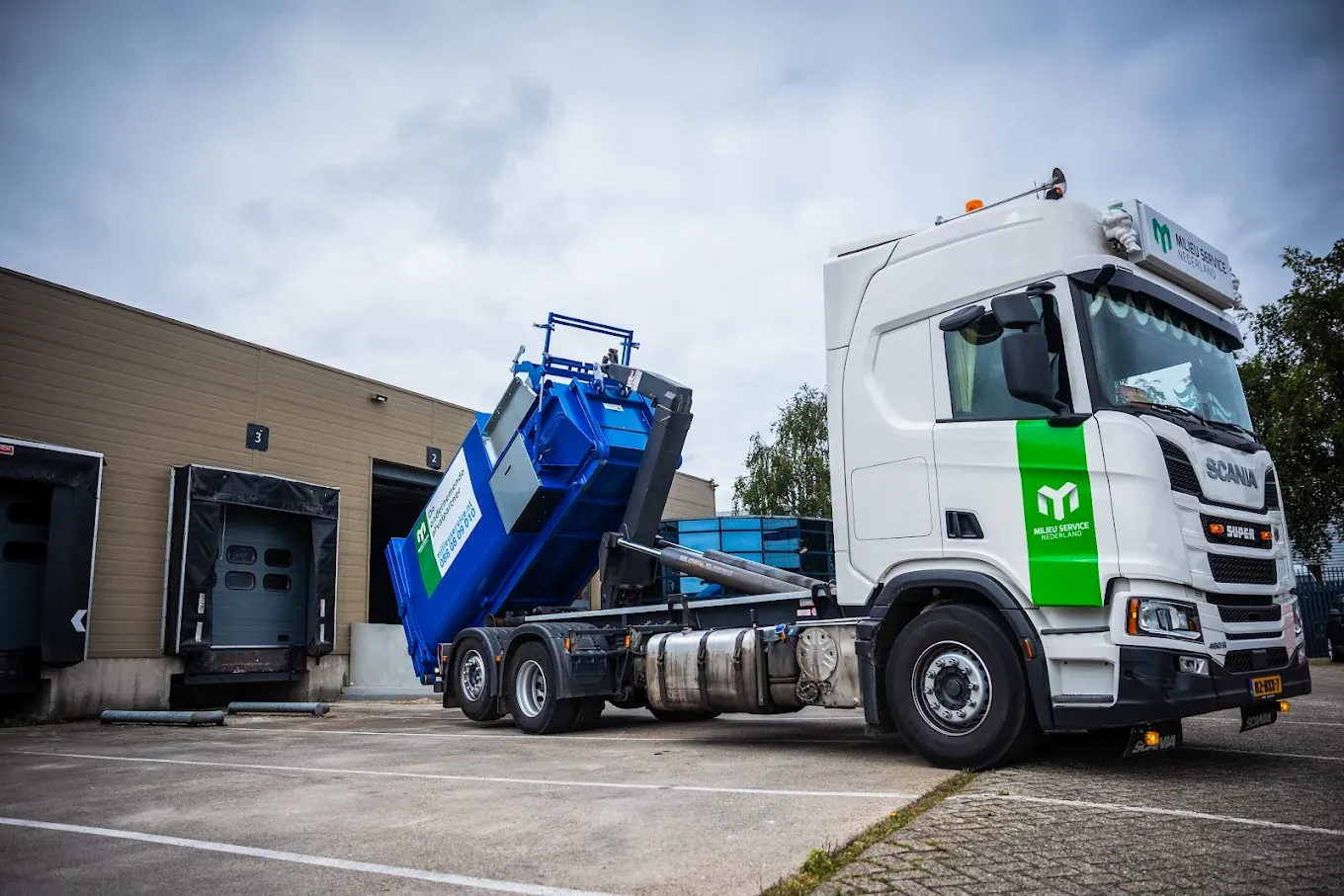
More than 70 vehicles operate every day with our D4T (Daisy4Trucks). Together, they account for approximately 1.75 million collections per year and keep around 157,500 tonnes of waste continuously under observation. In commercial residual waste, we measure an average of 40 to 50% recyclable material. If we conservatively calculate with the lower limit, that means that approximately 63,000 tonnes of recyclable material ends up in the incinerator each year. Not an average from a sample, but data that we can trace back to a specific customer, a specific container, and a specific collection.
(Last update figures 19/10/2026)
From measurement to avoided emissions
Making something visible is one thing. Doing something with it is another. That second part is our customers' work. A collector who knows which customer puts film in with the paper week after week has a different conversation than a collector who asks everyone to sort better.
Such a conversation does not turn things around in one go. Even so, we see that targeted customer awareness work quickly delivers around 3% less contamination per customer per year.
Across the entire fleet equipped with D4T, that currently means around 4,725 tonnes of waste per year moving from the incinerator to recycling. What that saves in emissions is not something we determine ourselves. We follow the official Dutch emission factors, which weigh the incineration route against the recycling route for each fraction. On average, every redirected tonne yields 1.3 tonnes of CO2, or around 5,670 tonnes of CO2 per year in total.
The journey that is never made
The second way D4T saves a significant amount of CO2 is by cutting out pointless journeys. Does D4T identify a load as non-conforming? Then the trip is never made, rather than made and rejected on arrival. This happens two to five times per month per vehicle, over an average distance of 30 kilometres.
Together that adds up to around 176,400 kilometres of heavy transport avoided per year, roughly three times around the equator, good for another 176 tonnes of CO2.
A greener future
The shift from incineration to recycling and the journeys avoided together add up to a saving of around 5,900 tonnes of CO2 per year across the active fleet. Or 90 tonnes per equipped vehicle. That last figure is the one that matters most, because in the coming years we intend to equip more and more vehicles with D4T. The more vehicles measure, the greater the impact we can achieve together.
Our ambition for the next five years is clear: to halve contamination in commercial residual waste, from 40 to 50% to around 20%.
What does that mean for your fleet? We would be glad to measure it.